Seoul Isn't Just the Backdrop. It's the Syllabus.
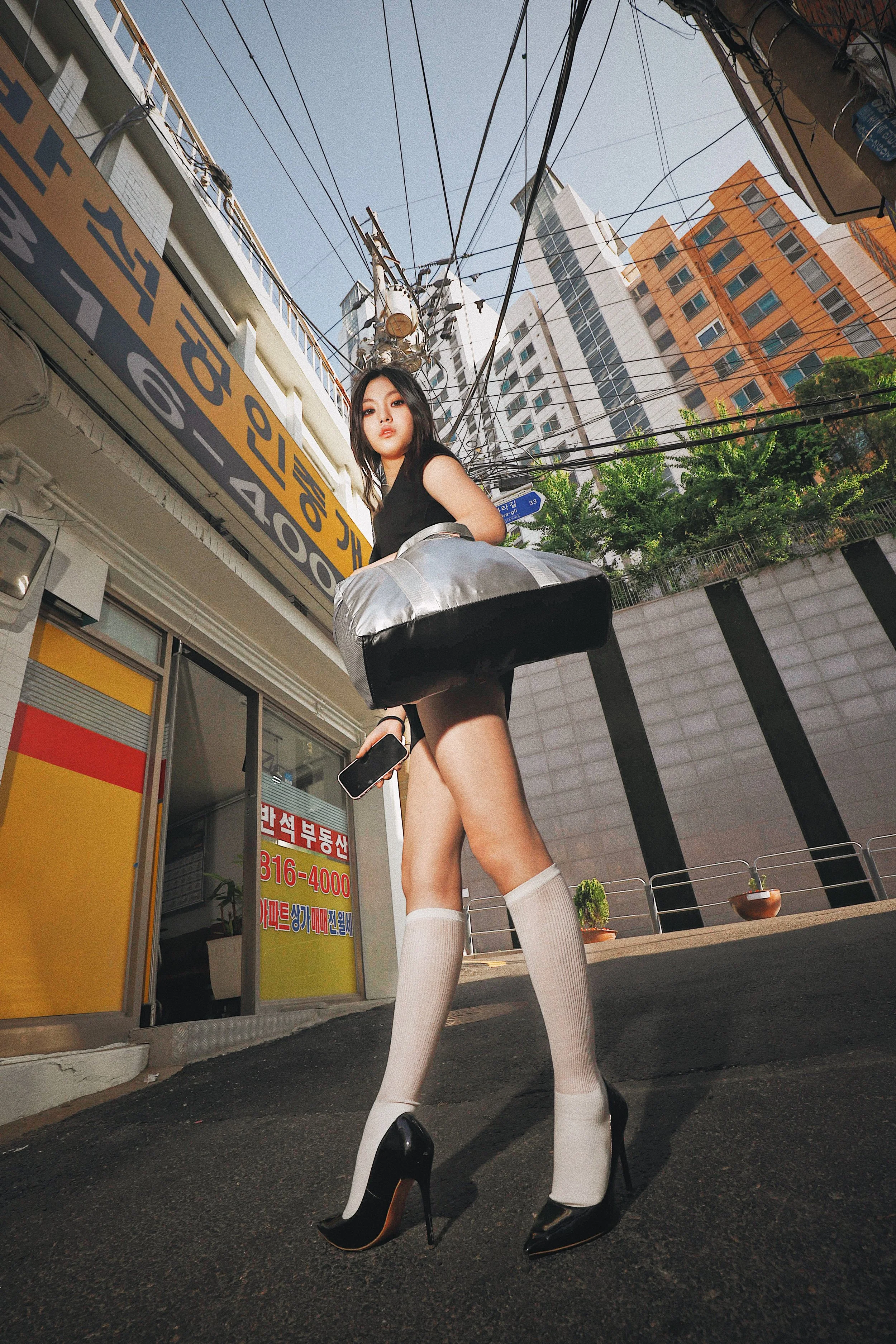
Model @0.8.730 stands at the convergence of old and new in Heukseok-dong, in front of one the real estate agencies that is likely helping make all the rapid neighborhoos change happen. The fill flas here is off camera and allows the camera to exposse for the very bright background, which tells us where are, while that flash takes care of evening out the foreground where the model stands.
Introducing The Seoul Method — a decade and a half of photography classes in Seoul, rebuilt for right now.
There's a photograph I took in early 2011 that I've never posted anywhere. It's a test shot from the first session of that month's beginner class — one of my students pointing a camera at a Korean model under two studio lights I'd set up in a rented space, completely frozen, because nobody had told her yet that the light from a strobe doesn't behave like the light from a window. She knew how to compose. She knew what she liked aesthetically. She had no idea how to expose for it.
By the end of that session she did.
That's been the whole point for a decade and a half.
It started before Instagram existed
In 2010 — the year Instagram launched, the year before the iPhone 4 came out — I was already running photography classes in Seoul. Not as a branded product with a website and a landing page. As a Facebook group called Photography Classes in Seoul, built around the simple idea that there were a lot of people in this city with decent cameras and no idea how to actually use them.
The group worked because Facebook worked. You posted an event, people showed up, money changed hands at the door, and you spent three hours in a café or a studio watching people's relationship with their cameras change in real time. By 2011 I was running multiple tracks simultaneously — beginner and intermediate — with studio sessions as premium add-ons. Lunar New Year intensives. "Shoot a Korean Supermodel" master classes. The works.
For almost a decade, that's how it ran. No formal branding. No booking widget. Just a Facebook group, a rented studio space I called Studio 11, and a rotating cast of students who came through Seoul — expats, long-term residents, tourists, serious hobbyists, people who'd just bought their first mirrorless and didn't know where to start.
To put that in context: I'm the longest-running foreigner teaching photography in Korea. Over those years the class has run alongside university-level teaching appointments — at Korea University, Yonsei, Konkuk, Hongik, and Korea National University of Arts, among others — covering everything from Visual Sociology and Understanding Korea through Photography to Understanding the Art of Photography and documentary production. I've also taught documentary photography to at-risk youth at Haja Center, Seoul's flagship alternative education institution. The students who showed up to Studio 11 on a Sunday afternoon were getting the same instructor their university counterparts were getting in a credited course, at a fraction of the price, with more hands-on time and no grade attached.
That's still true of The Seoul Method. What you're paying for is the best photography instruction available in this city, taught by someone who has been doing it longer than anyone else here — and the guarantee is simple: by the end of your session, you will understand your camera.
📷 [ARCHIVE IMAGE — suggested: an old Studio 11 class session photo, a Facebook group screenshot, or any image from the 2010–2019 era that shows the class in action. Doesn't need to be polished — authenticity is the point here.]
Then COVID happened. Specifically, what happened was Seoul's social distancing restrictions capped indoor gatherings at four people — and they did it at the worst possible moment. The winter of 2020 session had seven students signed up, some of the most serious and eager I'd seen in years. People who genuinely wanted to go deep. The class was at a peak in terms of enrollment and student quality, and that's exactly when the restrictions hit.
We tried. The eagerness was real and we didn't want to just cancel, so we attempted a virtual version of the course. It didn't work. The problem is that some of what this class teaches is irreducibly physical — you have to walk back and forth at different distances from a model and fire a strobe and watch the light change with your own eyes to truly feel the inverse square law. You have to be in a studio to understand what a studio does. You have to be on a Hongdae street corner with a flash in your hand and a stranger in front of you to learn what fill flash actually solves. None of that translates to a Zoom call. We stopped at the top — peak interest, peak enrollment, and a forced ending that had nothing to do with whether people wanted to learn.
That interest never really rolled off. And in the age of AI, I think it's actually intensified. People are starting to sense that something is being lost — that there's a value in getting back to the real, or at the very least the analog, which has taken on a kind of romantic charge in direct proportion to how much of our visual world has become generated rather than captured. That feeling is part of what The Seoul Method is responding to.
What also happened around the same time was Facebook. The platform that had reliably put class announcements in front of exactly the right people for nearly a decade fell off a cliff — not gradually, but sharply, the way platforms do when the algorithm stops caring about your posts. Between COVID killing the in-person format and Facebook killing the distribution channel simultaneously, it was easier to let the class linger in the background and dream fondly of reviving it someday.
The someday is here.
What the pause made obvious
When you run something continuously for years you stop seeing it clearly. The hiatus forced an audit. What was this class actually doing? What had I learned about how people learn photography? What had changed, and what had stayed exactly the same?
What stayed the same: the exposure triangle. Shutter speed, aperture, ISO — the three-way relationship that governs every photograph ever taken. People still didn't understand it. They still couldn't explain why a shot that looked right on the LCD turned out wrong when they got home. They still flinched at flash like it was going to bite them.
What changed: the students. The Seoul of 2025 is not the Seoul of 2010. The people coming to a photography class now are more visually sophisticated — they've been staring at Instagram for a decade, they have strong aesthetic instincts, they know what good looks like. But knowing what good looks like and knowing how to make it are completely different skills. The gap between vision and execution is if anything wider than it used to be, because the vision has gotten more ambitious.
What also changed: Facebook. The group still exists — but Facebook as a platform for finding and building a community of photo students is not the engine it used to be. The algorithm buries event posts. Organic reach is essentially dead. And a new, much larger disruption had arrived that made the Facebook problem look minor: AI. Suddenly everyone had a reason to ask whether learning photography was even worth it anymore — when a machine could generate a polished headshot from a selfie, why bother with aperture? That question deserved a serious answer, which I'll get to shortly.
The Seoul Method is the same class with better architecture
The Seoul Method isn't a new curriculum. The content is the same content I've been teaching since 2010 — the physics of light don't change, the relationship between shutter and aperture doesn't change, the reason flash looks like a crime scene photo when used wrong doesn't change.
What's new is the structure. Instead of a four-week course you have to commit to in full, The Seoul Method breaks into four standalone clinics — each one a complete session you can take on its own or as part of the series. Here's what actually happens in each one.
Reality Rules in the Time of AI
Here's the argument people are making right now: why learn photography when you can take a selfie, run it through an AI, and get back a polished corporate headshot that makes you look like the best version of yourself? It's fast, it's cheap, and the results are genuinely impressive. Why bother with aperture and shutter speed and flash when the machine will just handle it?
It's a reasonable argument. It's also shortsighted in a specific and predictable way.
Every major technology rollout follows the same arc. A new capability appears — cheap websites, Instagram face filters, ChatGPT, AI video — and the first wave of response is always a gold rush. People rush to monetize the novelty before it becomes common. Quick GPT-written books flooded Amazon. AI videos filled every feed. The output was everywhere, immediately, and then almost as immediately it became its own form of cringe. The honeymoon period with each new rollout is getting shorter. The disgust cycle is accelerating.
AI headshots are in that arc right now. They're impressive enough that people are using them. They're common enough that people are starting to clock them. They'll be cringe soon — not because the technology will get worse, but because the technology will get so good and so ubiquitous that the output becomes indistinguishable from a certain kind of uncanny perfection that humans are already developing an allergy to. We've watched this happen with every previous wave of digital image manipulation. Perfection becomes a red flag.
What survives the disgust cycle is always the thing grounded in physical reality. The thing that can't be faked because it required actual skill applied to actual stuff in the actual world. Photography is one of the few visual practices that is epistemically tethered to reality — the camera was there, something happened in front of it, and the image is evidence of that encounter. An AI image is a sophisticated hallucination. A photograph is a record. That distinction is not going to matter less as AI improves. It's going to matter more.
The cultural counter-movement is already visible. Film grain is back. Candid is beating posed. The "shot on film" aesthetic commands a premium precisely because it shows its seams — the slight blur, the imperfect exposure, the proof that a human made a decision in a real moment. We are already becoming allergic to the AI-smooth, the AI-perfect, the AI-inevitable. That allergy is going to intensify. There is going to be a sustained boom in demand for photography that is polished but visibly human — slightly blemished by reality, inflected by an actual person's actual judgment about what was worth capturing and how.
The live music parallel is instructive. Streaming didn't kill live performance — it made it more valuable. The ability to hear any recorded music instantly, perfectly, for free made the unrepeatable live experience more precious, not less. The same dynamic is coming for photography. The more AI can generate any image on demand, the more a photograph — a real one, made by someone who knows what they're doing with a camera and light and a moment — becomes the thing worth having.
Learning to professionally wield a camera and flash, to understand exposure well enough to photographically corral reality into a strong image — that is a skill tethered to the baseline of the physical world in a way that AI cannot replicate because it has no access to that world. It has to make reality up. You don't.
This is not a bad time to learn photography. It's probably the best time in a decade.
Why "The Seoul Method"
The name isn't branding. It's an argument.
Seoul has a visual infrastructure that most cities don't. The neighborhoods we work in aren't chosen because they're photogenic in a generic tourism sense — they're chosen because they produce specific photographic problems that teach specific skills, and because the city's broader visual culture makes those problems tractable in ways they wouldn't be elsewhere.
Start with the people. Seoul has a beauty habitus — and habitus here means something specific: the accumulated, embodied dispositions that get baked into you through years of living in a particular social environment. It's not conscious style or deliberate self-presentation. It's the way certain things come to feel natural, normal, obvious — the way you carry yourself, how you relate to being looked at, what you reach for when you get dressed. In Seoul, that habitus includes a deep comfort with cameras, with self-presentation, with being photographed as a normal part of social life. People here are aesthetically self-conscious in the best sense: styled, considered, camera-aware without being camera-hostile. Approaching a stranger in Hongdae to photograph them is a normal social transaction. In most Western cities it's an imposition. That difference isn't incidental to the course — it's what makes "Flash Forward" and "Controlled Chaos" function as learning environments rather than awkward exercises in public permission-seeking.
Then there's the model culture. "God Mode" requires a real subject in a real studio setup. The infrastructure for that — people who are comfortable in front of a camera, who understand what a shoot is, who bring genuine presence to the frame — exists in Seoul as a baseline. This is a city where being photographed is a normal part of creative life, not a special occasion.
And then there's the city itself as visual curriculum. Seoul's compressed modernity is part of what makes it such extraordinary raw material — this is a city that rebuilt itself at speed, layering decades of architectural history, economic transformation, and cultural reinvention on top of each other in ways that produce genuinely strange and generative juxtapositions. The flexible sociality that comes from that density — the way Seoul neighborhoods reinvent themselves, the way public and private bleed into each other on its streets — gives the city a dynamicism that translates directly into varied, visually rich shooting environments. Hongdae's hard shadows and open plazas are the product of a neighborhood that evolved around creative energy and youth culture. Seongsu's industrial bones give you surfaces that catch light hard, backdrops that do visual work without competing with the subject, and a neighborhood identity built substantially around its own ongoing aesthetic transformation.
There's also something worth naming directly: The Seoul Method is designed to give you intellectual satisfaction alongside camera skills. This isn't an academic course and it's not theoretical — but it is the kind of learning that reminds you of being in a great class in college, where you walk out understanding something about the world differently than when you walked in. The physics of light, the logic of exposure, the way a city's social infrastructure shapes what's possible photographically — these are genuinely interesting ideas, and understanding them makes you a better photographer and a more interesting person to talk to about photography. That's part of the package.
Seoul is a city that takes looking seriously — at fashion, at spaces, at itself. The infrastructure of visuality here: the cafés designed to be photographed, the streets that evolved around being seen, the beauty culture that makes self-presentation a collective project rather than a personal vanity — all of it becomes raw material in The Seoul Method. You couldn't run this exact course in most cities because the ingredients aren't there.
The Seoul Method is called that because Seoul isn't just the backdrop. It's the syllabus.
Foundations — 3 hours, in-person or virtual
₩100,000 in-person / ₩75,000 virtual
Every camera sold in the last twenty years has an auto mode, and auto mode is a trap. Not because it produces bad photos — it often doesn't — but because it produces photos you don't understand. You can't reproduce what worked. You can't fix what didn't. You're a passenger.
I had a mentee not long ago who shot with a Leica. A real one. She was documenting something genuinely worth documenting, she had a good eye, and she eventually published a photo book. That's not nothing — most people who buy a camera never produce anything that coherent, let alone a finished book. But she was shooting almost entirely on auto, and the fundamentals of shutter, aperture, and ISO were a gap neither of us fully addressed while we were working together. I didn't want to pick at it. She was making pictures, the project was moving forward, and sometimes you make that call.
What stayed with me was the question I couldn't stop asking: how much more could she have done with that camera if she understood what it was actually capable of? A Leica on auto mode is a very expensive point-and-shoot. The same camera in the hands of a photographer who understands every relationship between every dial is a beast — it does things auto mode would never think to do, in conditions auto mode would give up on, producing images that couldn't exist any other way. The photos she published were well-exposed. What she couldn't have known — because nobody had walked her through it — was which shots she couldn't take. The ones that required her to override what the camera thought it should do and tell it exactly what she wanted instead. Those shots didn't exist in her book, not because she lacked vision, but because she didn't yet have the technical vocabulary to execute it.
That's the auto mode trap. It doesn't stop you from making decent pictures. It stops you from making the pictures you couldn't have made any other way.
Foundations exists to close that gap.
The core of it is what I call the Holy Trinity: ISO, shutter speed, and aperture. The order matters. ISO first — that establishes your baseline sensitivity to light, the foundation everything else builds on. Then shutter and aperture as a pair, because they're always in conversation. More aperture means you need faster shutter or lower ISO to compensate. Faster shutter means you need more aperture or higher ISO. Change one and the other two respond.
Most people learn these as three separate dials. That's why they stay confused. They're one system.
By the end of three hours you'll be shooting in full manual — not because manual is inherently superior to aperture priority, but because until you can control all three consciously, you don't actually know what your camera is doing. After "Foundations" you'll be able to look at a shot that didn't work and immediately know why. That's the skill.
Of the four Seoul Method clinics, "Foundations" is the only one that offers a virtual attendance option — meaning you can join in-person or remotely, whichever works for you. The other three clinics are in-person only because they require you to be physically present in specific Seoul locations. Virtual students complete a pre-class assignment — shoot one bright scene, one dark scene, send both before the session starts. During class, an assistant runs a live phone feed as a Zoom participant showing real-time reference exposures so virtual students can calibrate against something concrete. The price difference between in-person and virtual is real: you won't get real-time correction from me on your specific images the way in-person students do. That gap is the ₩25,000.
Flash Forward — 3 hours, Hongdae (홍대)
₩150,000
Flash has a reputation problem. People either avoid it entirely or use it wrong — on-camera, full power, pointed straight at the subject's face — and then wonder why every flash photo looks like a police evidence photo. The answer isn't to stop using flash. The answer is to understand what flash actually is: a controllable light source you carry in your bag.
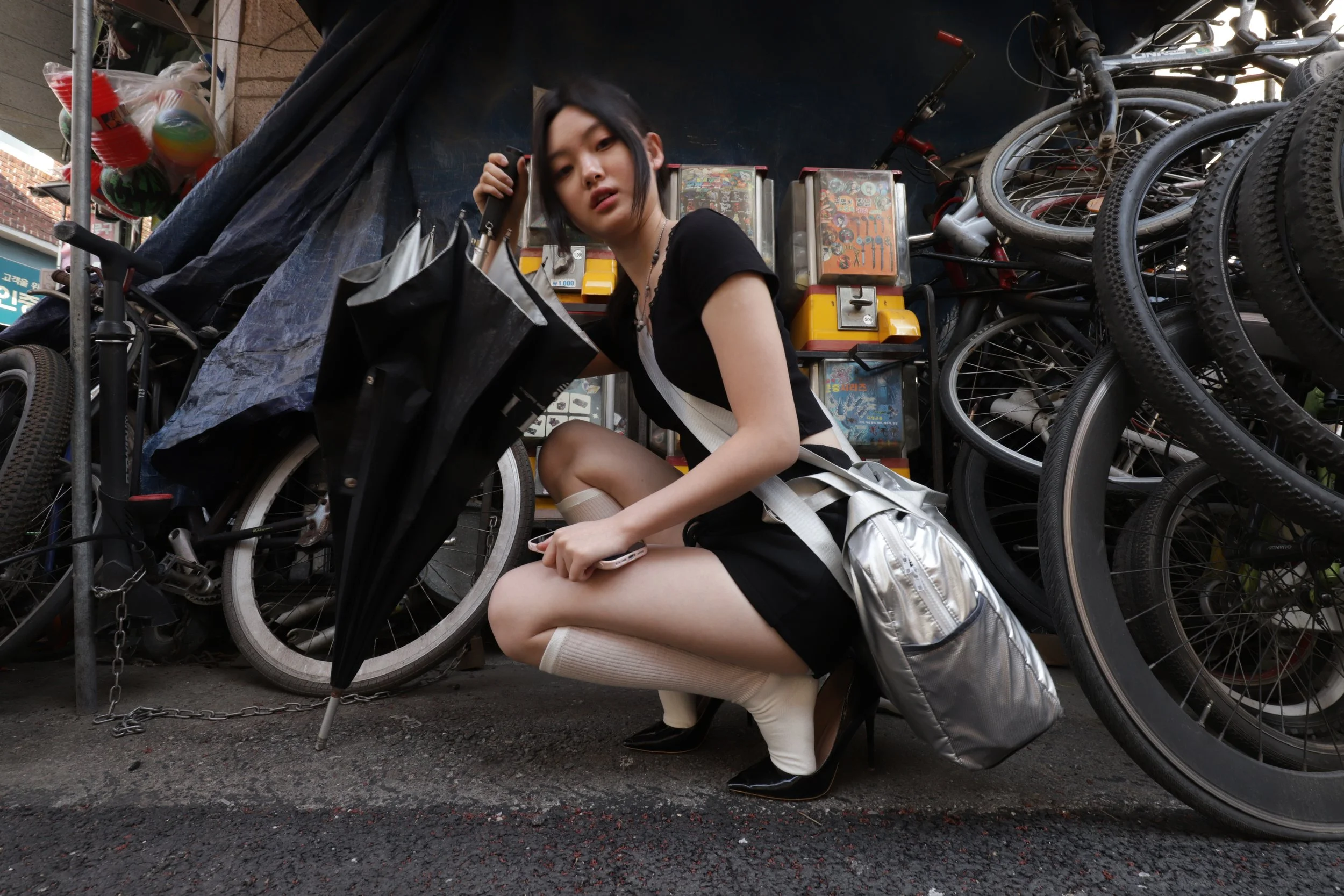
Natural light only, 흑석동 (Heukseok-dong) — 흑니단길 (Heuknidan-gil). The overcast sky is one giant soft box, which means the shadows are soft but the light is coming entirely from above and is extremely directional. The fall-off into shadow is gradual rather than hard, but it's still all top-down — which means unflattering shadows under the eyes, nose, and chin. Lifting the exposure in post brightens the frame but doesn't change where the light is coming from. That's the problem.
Flash Forward starts with the thing nobody explains clearly: sync speed. Your camera has a maximum shutter speed at which it can sync with a strobe — typically 1/200 or 1/250 of a second depending on your system. Go above it and you get a black band across your frame where the shutter curtain wasn't fully open when the flash fired. This is the mistake that makes people think flash is complicated. It isn't. It's just a setting.
Once you understand sync speed, outdoor flash stops being intimidating and becomes logical. Here's the move: expose manually for the sky — get it where you want it, clouds with texture and drama, not blown out white — and then add flash to light the subject separately. The sky and the subject are now on different exposure tracks. You control each one independently. This is fill flash, and it's what separates snapshots from photographs.
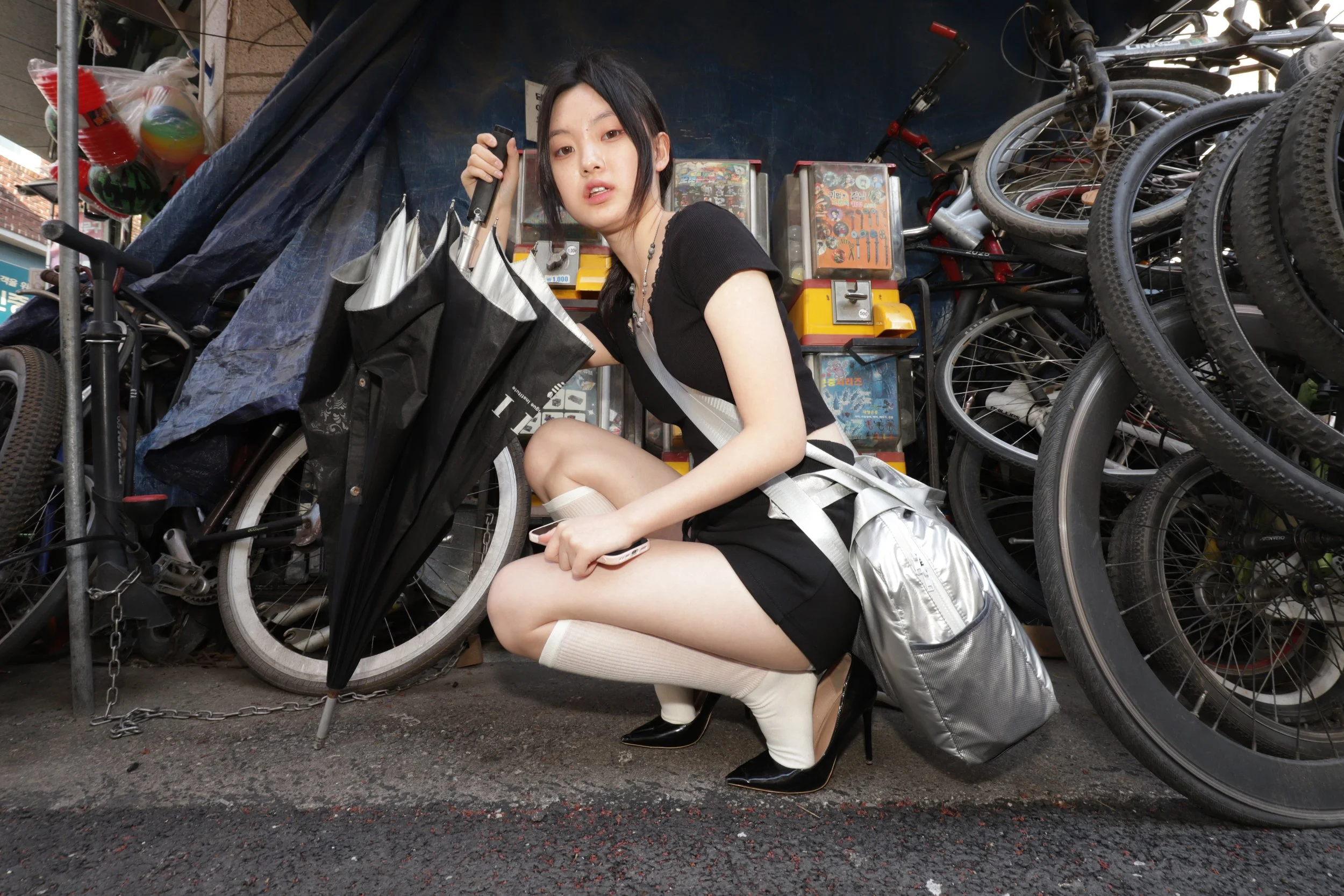
Same corner of Heuknidan-gil, same ambient exposure — now with a single speedlight. The flash isn't filling here so much as it's taking over: it becomes the key light, pushing from the front and effectively overriding the top-down ambient as the dominant source. The overcast sky drops back to fill and background. The shadow structure inverts. That's the move.
We do this in Hongdae (홍대), Exit 9, for two specific reasons. First, foot traffic — Hongdae on a weekend gives you a constant stream of interesting people willing to be photographed, which means you're not standing around waiting for a subject, you're making decisions continuously. Part of the exercise is stopping passersby and asking to photograph them on the spot — real ethnographic work, with real social stakes. That slight pressure is intentional. Working under a little pressure focuses you in ways that a comfortable controlled environment never will. It creates diamonds. In the summer sessions specifically, you'll be working under actual heat as well as social pressure — Seoul in July is not a temperate classroom, and learning to make good pictures while sweating is its own useful skill. Second, light — Hongdae's mix of tall buildings, narrow alleys, and open plazas means you'll encounter hard shadows and bright patches within steps of each other. That's exactly the condition where fill flash earns its place. A subject standing in open shade with a bright street behind them is a fill flash problem. A face half-eaten by shadow from an awning overhead is a fill flash problem. Hongdae manufactures these situations constantly, which means you're solving real problems rather than doing exercises. By the end of three hours you'll have made outdoor flash shots that look intentional, because they were.
God Mode — 3 hours, studio
₩180,000
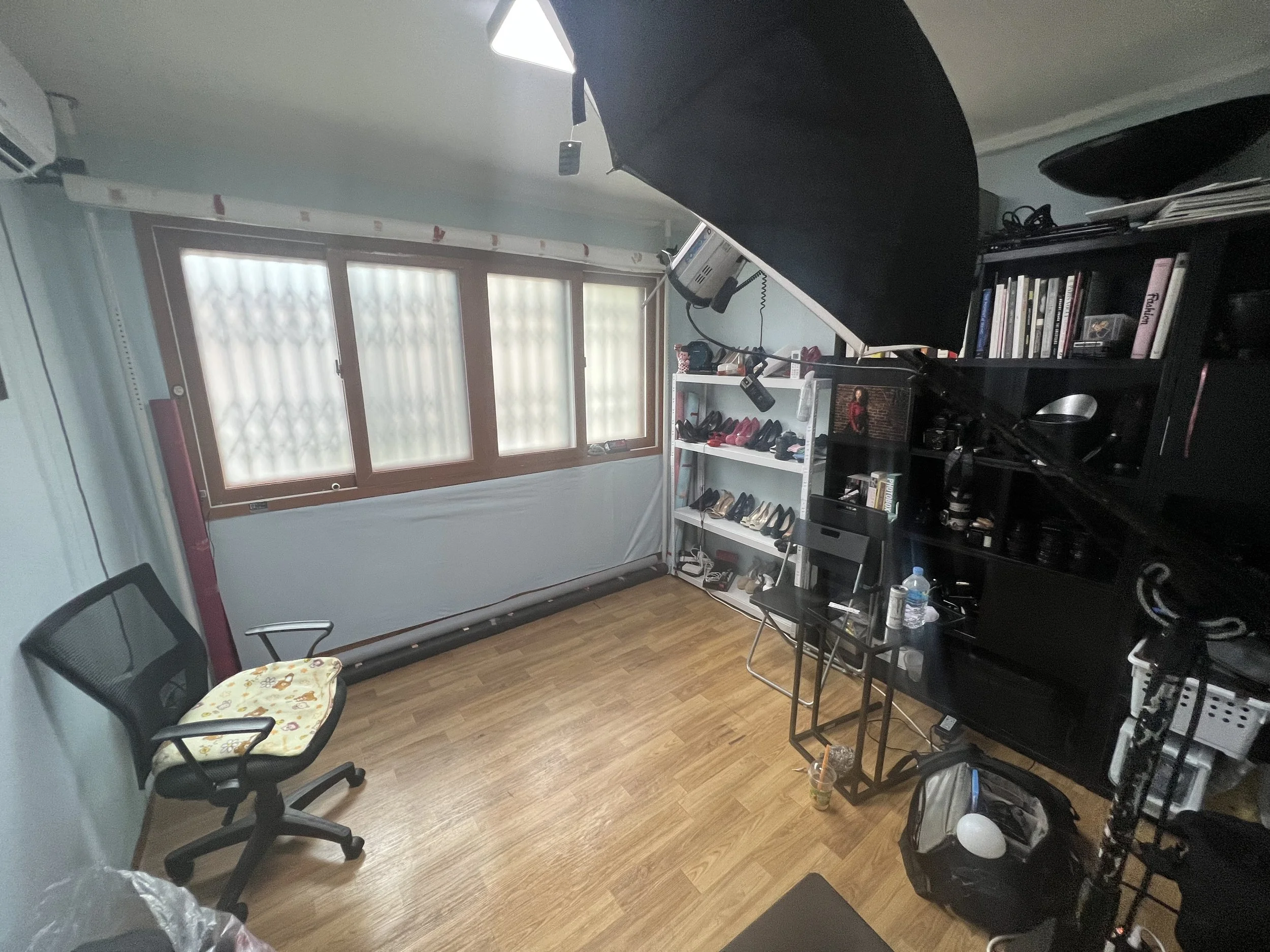
Even in my tiny work studio/storage closet, I can do a lot of damage. You can see my oft-used large umbrella reflector moutned high and in the middle of where the model would stand, offering a direct, no-shadows light that looks easily and strongly editorial for pretty much anyone who steps in front of it. One thing about good studio strobe work – it does not require fancy spaces or amenities. More than anything, a good studio tends to wide and deep in surface area, with high ceilings.But short of that, it’s mostly about just having good photo background paper and a couple proper lights and angles.
Here's what studio photography teaches you that no amount of outdoor shooting can: when you control every variable, you see exactly what each variable does.
Outside, light is always changing. The sun moves. Clouds pass. You're reacting. In the studio, nothing moves unless you move it. The key light is exactly where you put it. The fill ratio is exactly what you set it to. The background is exactly as bright or dark as you want. This kind of total control is what I mean by God Mode — you're not working with the light you're given, you're building the light from scratch.
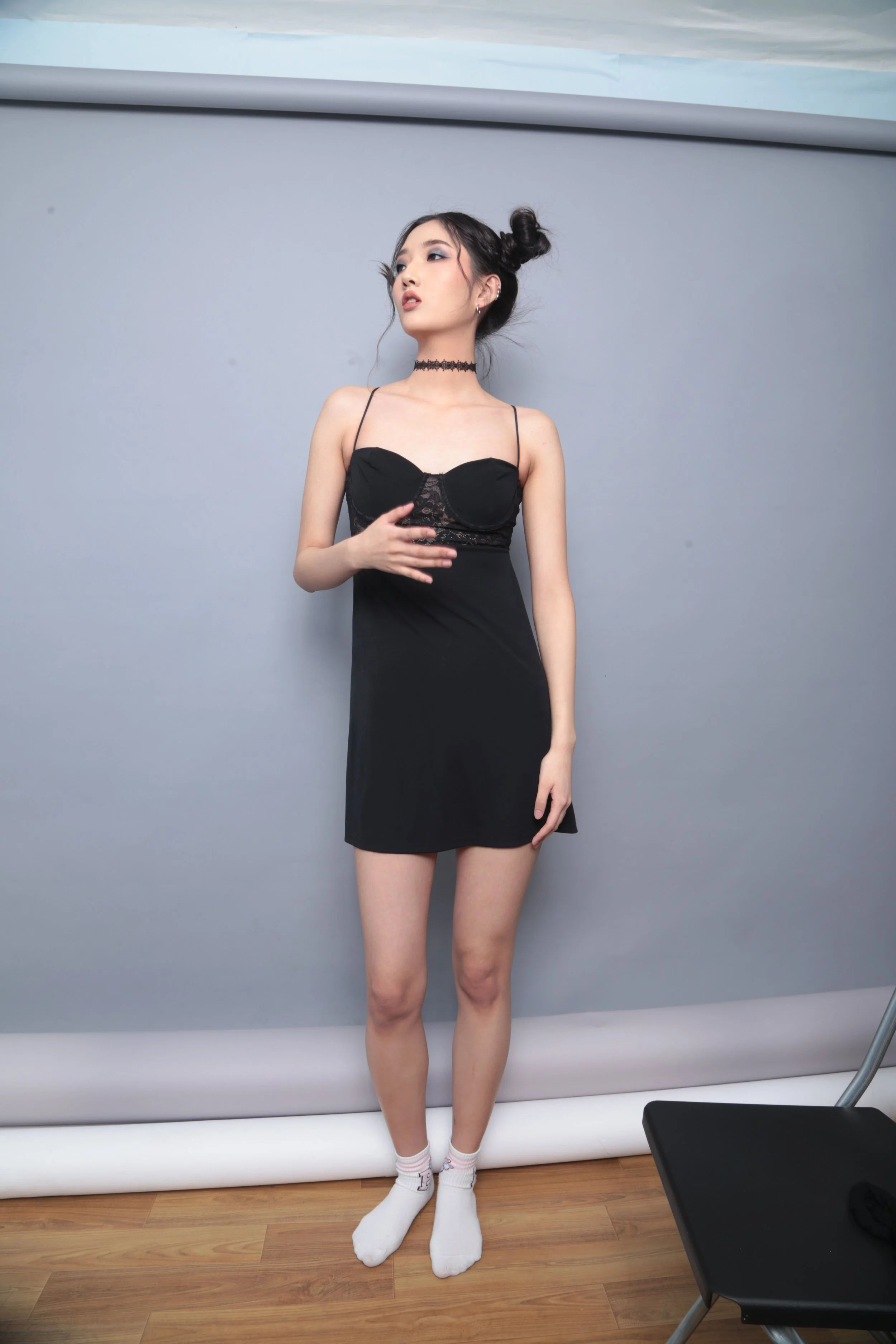
Model @clap_been79 and just the bare basics of what we needed to give her an edgy head shot. We just needed the paper and one light. Oh, and hair and makeup.
The session works around a real model, assisted by Korean photography students who've done this before and bring genuine energy to the room. (This is not a posed, awkward hour of you and a stranger staring at each other — it's a working session.) We build at least two full lighting setups during the three hours: one with a single key light so you understand what one source does before you add anything, and one multi-light setup with fill and separation.
By this point in the series you'll already be familiar with the inverse square law from "Flash Forward" — the principle that doubling the distance between your light and your subject gives you a quarter of the light, not half. In "God Mode" you feel it in a completely new way. Indoors, with a light on a stand you can physically move, the law stops being abstract and becomes something you can see happening in real time. This is why moving a studio light a foot closer or further does more than you expect. It's also why background separation is easy when you know what you're doing — put the subject far enough from the background and the light falls off naturally, no additional effort required.
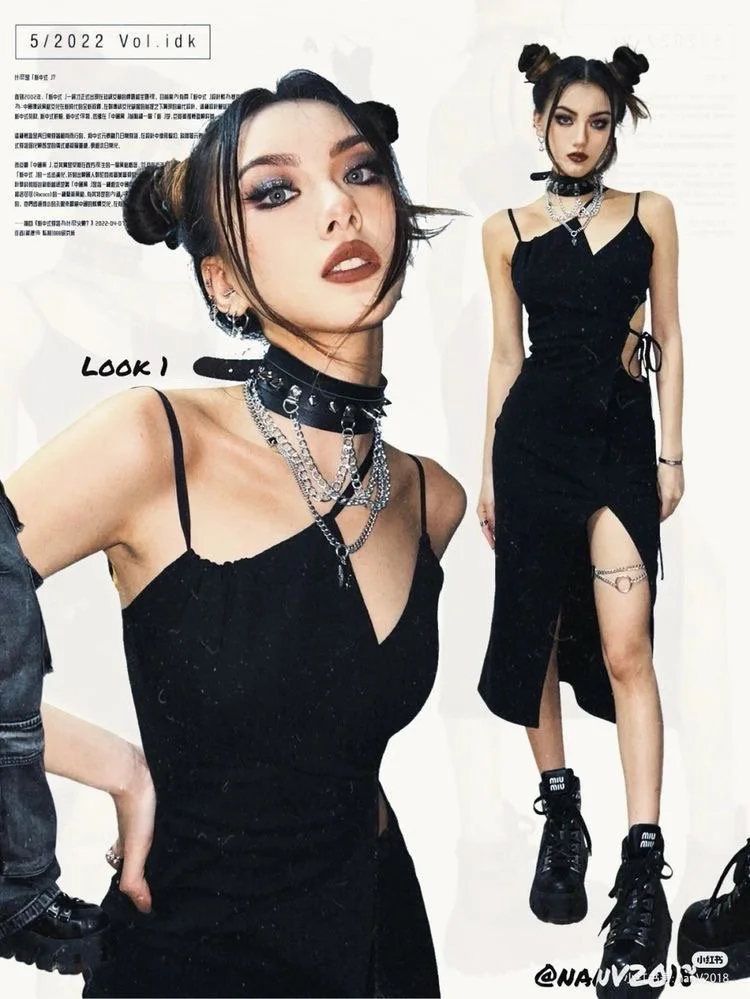
The inspo.
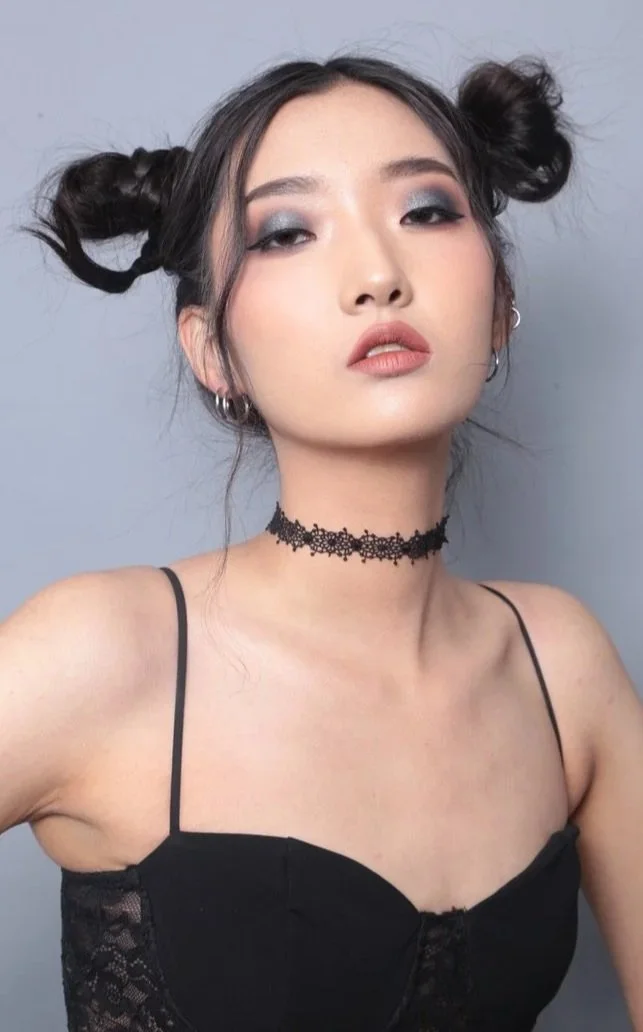
Model @clap_been79 after a trip to makeup artist @marcelarin_makeup and then arriving at our little work studio for the headshot. A ZARA dress stood in for the one in the artist’s mockup; and I think we pretty much got it.
What most students discover in "God Mode": the technical control they develop in three hours fundamentally changes how they see available light outdoors. After spending three hours deciding exactly where the light goes, you start reading ambient light the way an architect reads a building. "God Mode" is where the other clinics start making more sense retroactively.
Controlled Chaos — 3 hours, Seongsu (성수)
₩150,000
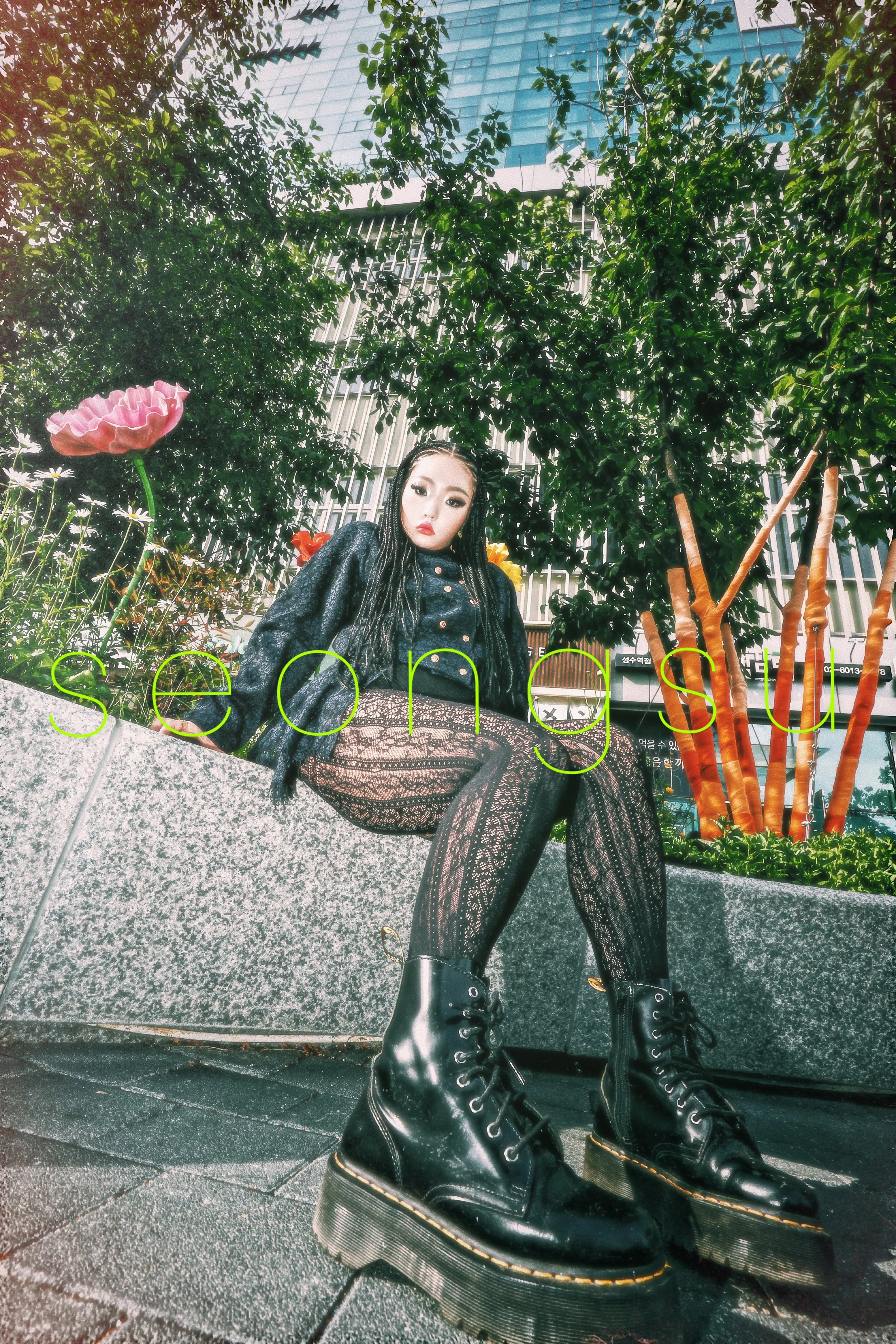
Model @maya_inshallah sits in Seongsu in partial shadow, with mainly her boots bathed in the sublight, but with the flash bringing up the levels of the rest of her body so it doesn’t look like there’s a sun/shadow situation at all.
Everything from the previous three clinics, outside, with variables you didn't choose and can't control. Welcome to actual photography.
Controlled Chaos is what the whole series builds toward. You arrive with the exposure triangle internalized, fill flash in your hands, and studio lighting logic in your head. Then Seoul does what Seoul does: the light changes, strangers walk through your frame, the background isn't what you planned, and you have to make pictures anyway.
The word "controlled" in the name is doing real work. Controlled Chaos isn't about surviving chaos — it's about bringing enough technical fluency that the chaos becomes material rather than obstacle. When you know your sync speed, you're not stressed about it. When you know your flash compensation, you're adjusting it without thinking. What used to be a problem becomes a decision.
Seongsu (성수) is the right location for this because it gives you genuine range: industrial architecture that catches light hard and interesting, street corners where ambient and artificial light mix in ways you have to solve rather than plan for, and enough visual texture that the background does half the work if you position correctly. It's also a neighborhood that rewards the kind of attentive seeing that good photography requires — there's always something happening you didn't expect.
We work with multiple remote flash units in this session. Placement, power ratio, and triggering are all things you'll handle yourself. By the end you'll have made street fashion photographs that look like you meant every element of them. Because you did.
Take all four, or just one
The Seoul Method is designed to be modular. You can take a single clinic if that's what you need — Foundations if you've been shooting in auto and want out, God Mode if you've been wanting to try studio work, Flash Forward if outdoor flash has been intimidating you. Each session is complete on its own.
You can also take all four. The bundle is ₩500,000 — that's ₩80,000 less than buying them separately — and it's the full arc from knowing nothing about manual exposure to making multi-strobe street fashion photographs in Seongsu.
Foundations — ₩100,000 in-person / ₩75,000 virtual
Flash Forward — ₩150,000
God Mode — ₩180,000
Controlled Chaos — ₩150,000
All four — ₩500,000
Payment via KakaoPay, PayPal, or on-site card reader (할부 / installment available for Korean cardholders).